As photovoltaic generation continues to expand across utility- scale solar fields,energy storage is becoming a critical infrastructure component. This white paper explores the role of AC coupled energy storage systems in modern PV plants and introduces a high-voltage, integrated solution designed to meet grid, safety, and efficiency requirements.
Industry Context &Market Challenge
Why AC-Coupled Energy Storage Is Becoming Essential for PV Fields
The rapid growth of utility-scale photovoltaic plants has significantly increased renewable energy penetration
across power grids worldwide.While this transition supports decarbonization goals,it also introduces new technical and operational challenges.
Large PV fields often experience:
·Power curtailment during peak solar generation
·Voltage and frequency instability,especially in weak grids
·Limited grid acceptance due to ramp-rate and power factor requirements
·Increasing compliance pressure from evolving grid codes
Traditional PV plants were designed for one-directional energy delivery.
However,modern grids require flexibility,controllability,and dispatchability.
Energy storage is no longer an optional add-on -it has become a grid requirement.
AC-coupled energy storage has emerged as a preferred architecture for large PV fields due to its flexibility, scalability,and compatibility with existing PV infrastructure.
AC-Coupled Storage Architecture Explained
Understanding AC-Coupled Energy Storage in PV Plants
An AC-coupled energy storage system connects directly to the AC side of a photovoltaic plant,typically at the same voltage level as the PV inverter output or the plant's collection bus.
In atypical AC-coupled architecture:
·PV arrays generate DC power
·Grid-tied PV inverters convert DC to AC
·Regulate the overall system energy demand through
·Energy storage systems connect independently to the AC bus
Unlike DC-coupled systems,AC coupling allows PV generation and energy storage to operate independently.This provides greater design flexibility and enables storage to be added without modifying the DC side of the PV system.
AC-coupled storage is especially suitable for:
·Utility-scale PV plants
·Multi-inverter solar fields
·Retrofit projects adding storage to existing PV assets
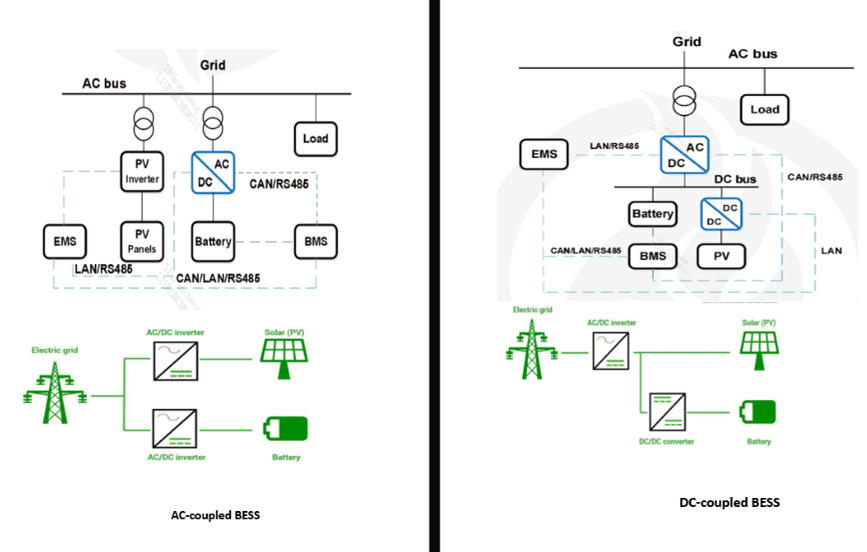
Difference between AC-coupling and DC-coupling ESS Application
Value Proposition for PV Field Applications
High Convenience for Retrofit and Deployment
For existing grid-connected photovoltaic systems,AC-coupled energy storage solutions can be deployed without modifying the original PV inverters,DC components,or array configuration.
The storage system is connected on the AC side,enabling a rapid upgrade of energy storage capability. This plug-and-play characteristic significantly reduces:
·System retrofit costs
·On-site construction complexity
·Project downtime during installation
As a result,AC-coupled solutions are particularly suitable for retrofitting existing PV plants and for projects where energy storage is introduced in phases.
Flexible Equipment Selection and System Integration
In an AC-coupled architecture,PV inverters and energy storage inverters operate independently on the AC side.This separation provides greater flexibility in equipment selection.
As long as grid codes and communication standards are met,system designers and EPC contractors can freely select:
·PVinverters and storage systems from different manufacturers
·Equipment models based on budget,performance,and certification requirements
This flexibility helps avoid vendor lock-in and allows project stakeholders to optimize system design according to technical,commercial,and regional regulatory considerations.
Strong Scalability and Capacity Expansion Capability
In AC-coupled systems,PV generation and energy storage operate as relatively independent subsystems on the AC side.Capacity expansion is primarily limited by the AC distribution infrastructure rather than the DC-side configuration.
In practice:
·PV capacity can be expanded independently within the allowable AC capacity
·Energy storage capacity can be increased without reconfiguring the existing PV system This staged expansion capability makes AC-coupled solutions well suited for:
·Projects with evolving load demand
·Phased investment strategies
·Long-term asset operation requiring flexibility and adaptability
High Technology Maturity and System Reliability
AC-coupled energy storage systems are based on standardized and well-established AC interconnection technologies, ensuring strong compatibility with existing grid infrastructure and electrical equipment.
This architecture has been widely deployed across global markets and benefits from:
Mature design standards
Clear engineering boundaries
Standardized installation procedures Proven operational performance
As a result,AC-coupled systems offer high reliability and repeatability in large-scale PV projects,while reducing technical complexity for system integration and operation.
Lower Operational Safety Risks on the AC Side
Energy storage systems in AC-coupled architectures typically operate at standardized AC voltage levels.Compared with high-voltage DC bus systems,AC-side operation presents:
Lower arc-flash risk
More manageable insulation and protection requirements
Improved safety margins during installation and maintenance
These characteristics contribute to enhanced operational safety,making AC-coupled storage systems particularly suitable for long-term,grid-connected PV applications.
Overall,AC-coupled energy storage systems offer a balanced combination of deployment flexibility,equipment independence,scalability,technical maturity,and operational safety.
They have become one of the most widely adopted and engineering-proven storage architectures for grid- connected photovoltaic plants.
For PV projects that prioritize reliability,expandability,and long-term asset value,AC-coupled energy storage represents a highly practical and future-ready solution.
Design Challenges in AC-Coupled PV Storage
Key Engineering Challenges in Large-Scale AC-Coupled Systems
While AC-coupled architecture offers significant advantages,large PV field deployments also introduce technical challenges:
·Integration across multiple AC voltage levels
·Maintaining high PCS efficiency at utility-scale power
·Compliance with grid codes such as LVRT and HVRT
·Fire safety and thermal management in large battery clusters
·Complex coordination between PV inverters and storage systems
If these challenges are not addressed holistically,system efficiency,safety,and grid compliance may be compromised.
A successful AC-coupled solution requires high integration, high voltage compatibility,and grid-ready design.
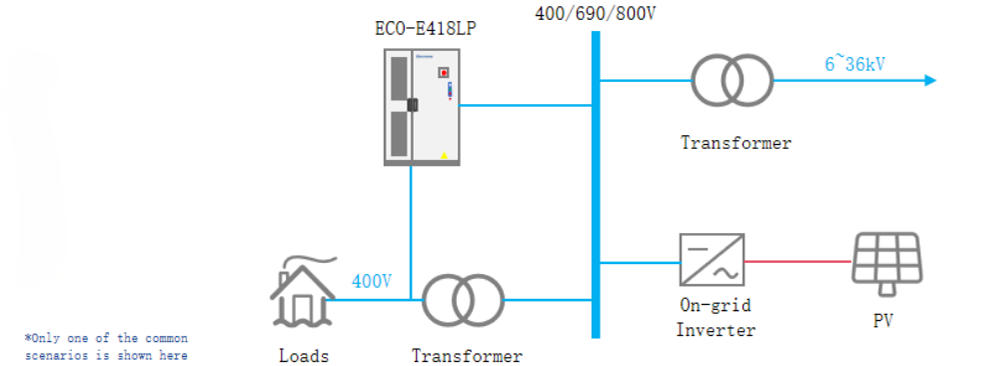
418kWh 800V AC-coupled ESS Application
Elecnova AC-Coupled Storage Platform
ECO-E418LP:An AC-Coupled ESS for PV Fields
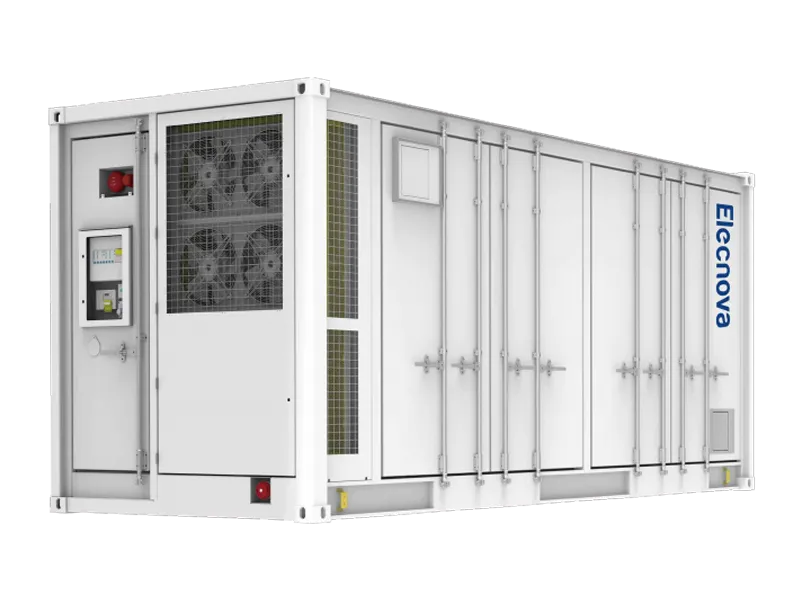
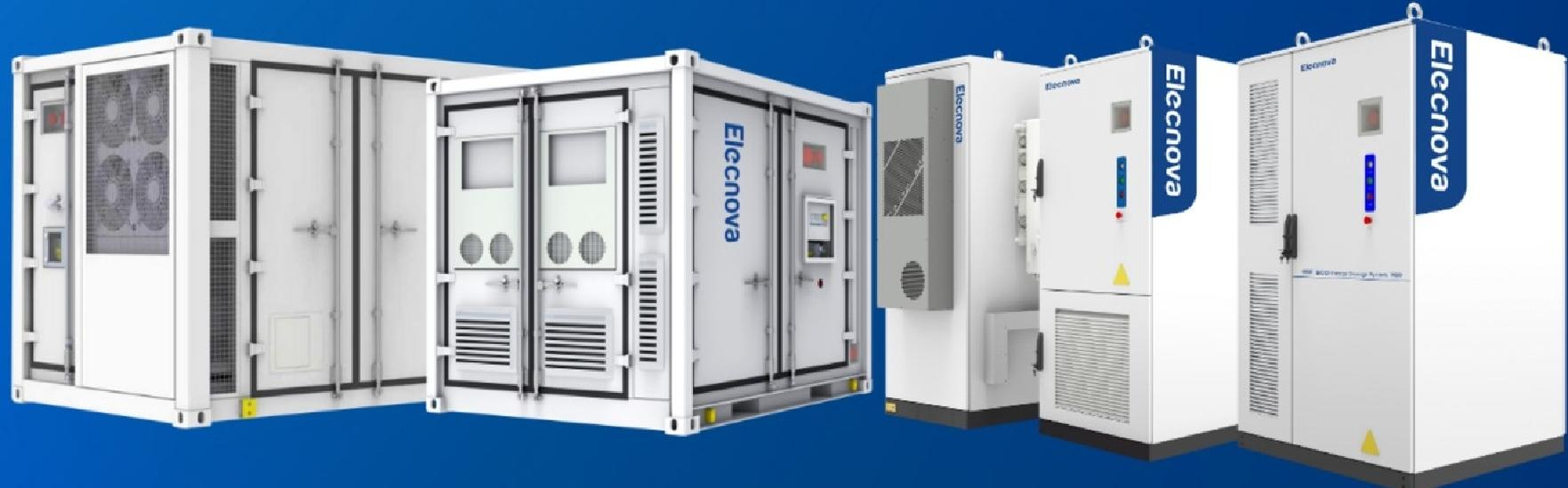
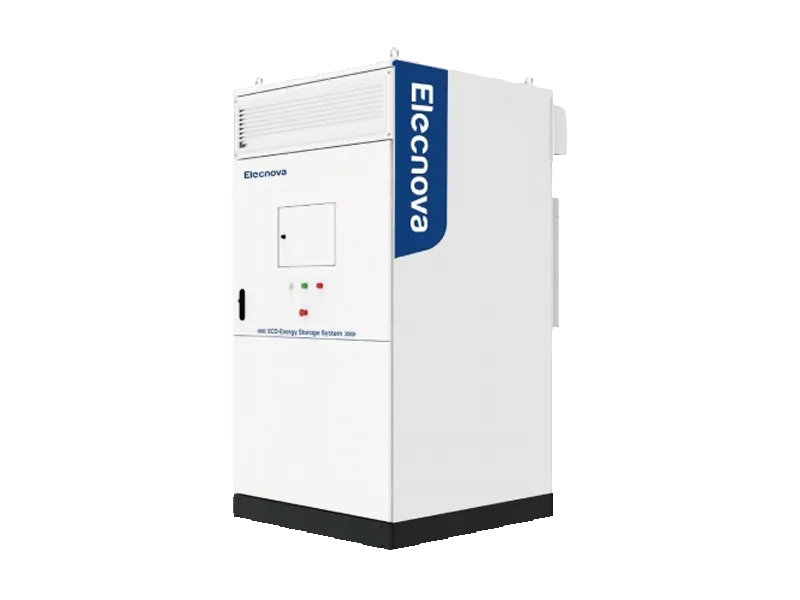
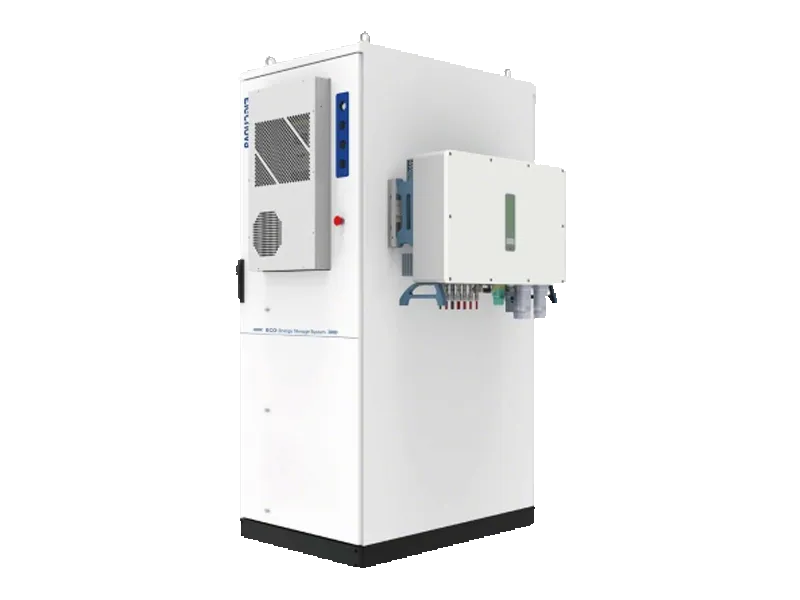
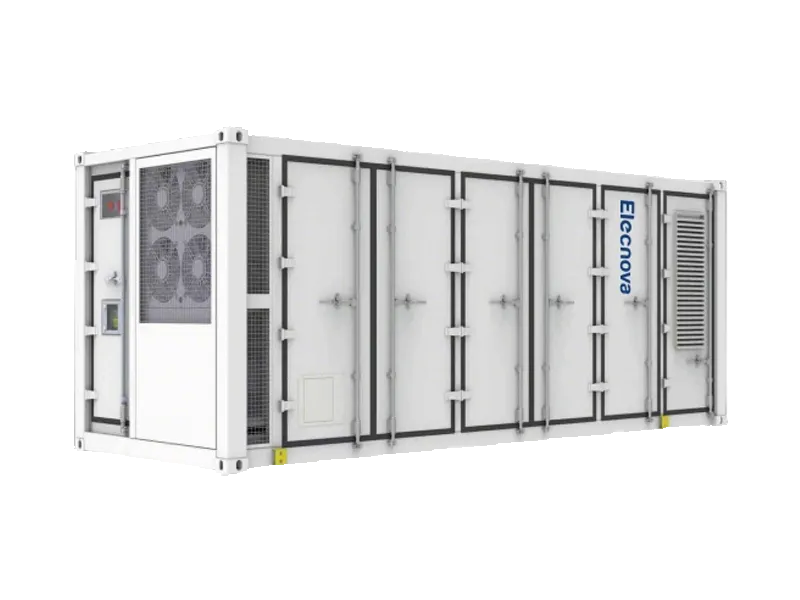
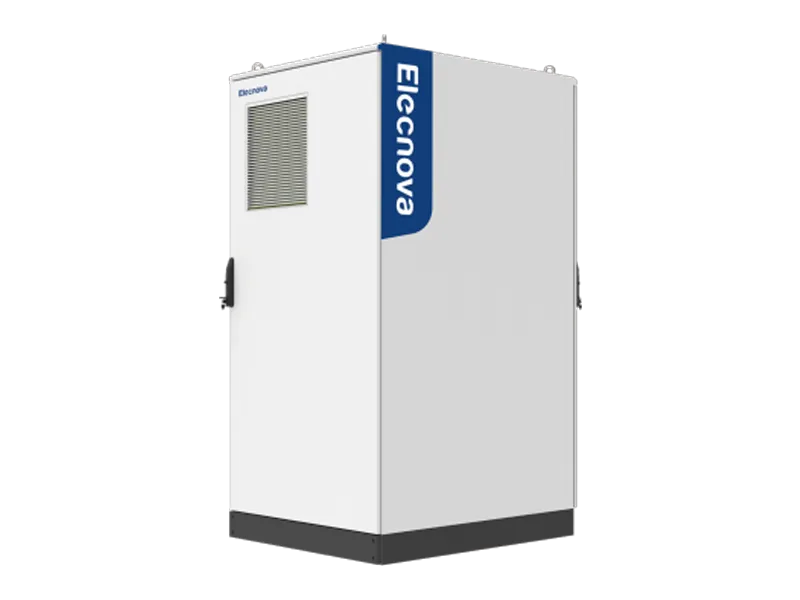
The ECO-E418LP series is a highly integrated,liquid-cooled energy storage cabinet developed specifically for AC- coupled photovoltaic applications.
Key features include:
·418 kWh energy capacity in a single all-in-one cabinet
·High-efficiency PCS up to 210 kW
·AC voltage options:400 V,690 V,and 800V
·Integrated battery system,PCS,BMS,EMS,cooling unit,and fire protection
By supporting AC interfaces,the ECO-E418LPenables direct connection to modern PV plants,reducing current, cable losses,and balance-of-system costs.
One cabinet.One AC connection.One complete storage solution.
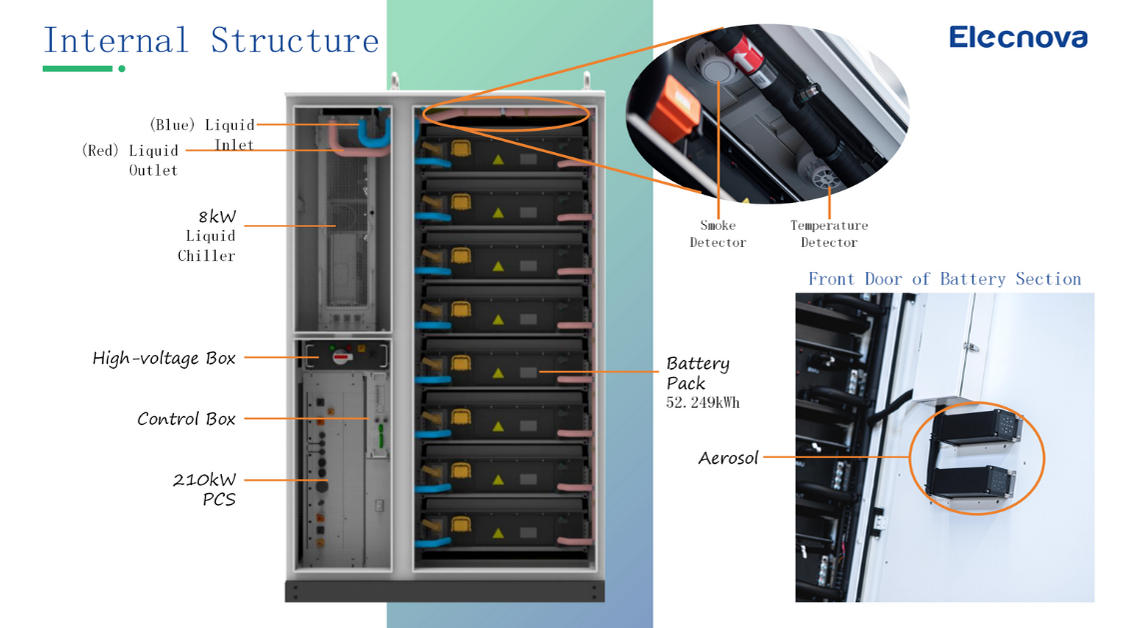
PV Farm BESS 210kW/418kWh 80OV AC-Coupled
Typical AC-Coupled PV Field Solutions
Application Scenarios with ECO-E418LP-A40
Direct High-Voltage AC Coupling
For PV plants using 400V grid-tied inverters,ECO-E418LP-A40 can connect directly to the AC bus without additional step-up transformers.
This architecture delivers:
·Higher system efficiency
·Reduced equipment count
·Faster installation and commissioning
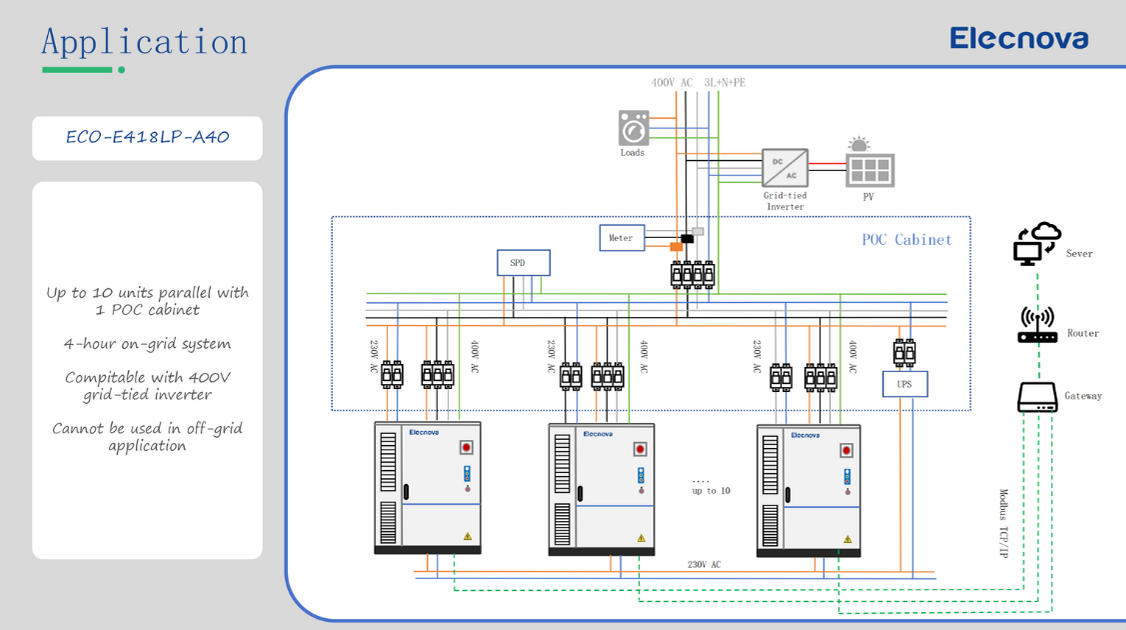
ECO-E418LP-A40 Application
Typical AC-Coupled PV Field Solutions
Application Scenarios with ECO-E418LP-A69/A80
AC Coupling with POC and Transformer
For 690V or 800V PV fields,the energy storage system need additional 400V auxiliary power supply,the storage system can be integrated through a centralized point-of-connection(POC) cabinet with transformer integration. This approach provides:
·Unified system coordination
·Simplified auxiliary power supply
·Flexible plant-level control
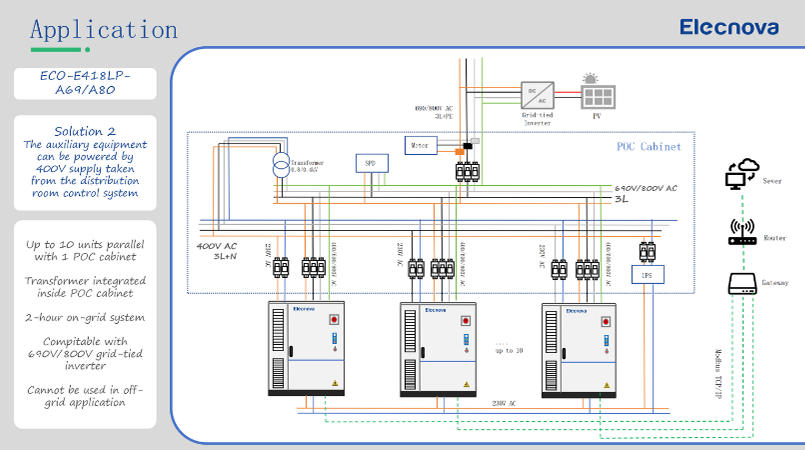
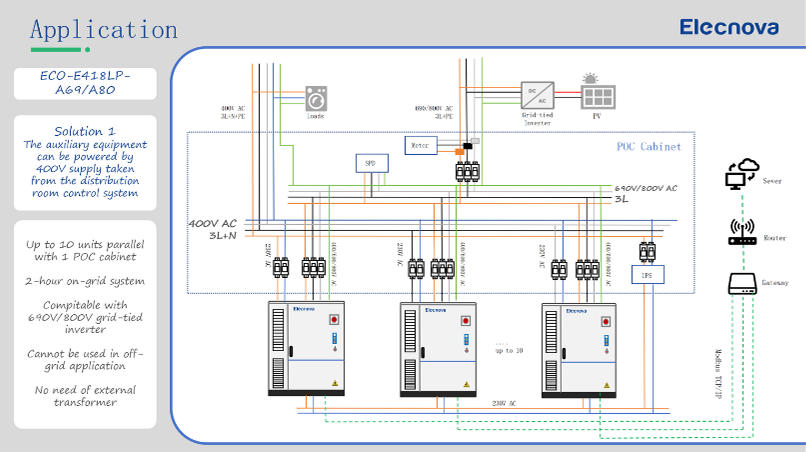
ECO-E418LP-A40 Application
Safety,EMS &Conclusion
Built for Grid Stability,Safety,and Long-Term Operation
Utility-scale PV fields often operate in remote and unattended environments.The ECO-E418LP integrates
multi-layer safety mechanisms,including cel-level monitoring,pack-level and cabinet-level fire protection,and outdoor-ready enclosure design.
The system is managed by an open,intelligent EMS that enables:
·Peak shaving and time-based energy shifting
·PV inverter coordination and zero-export control
·Integration with third-party EMS platforms through open APls
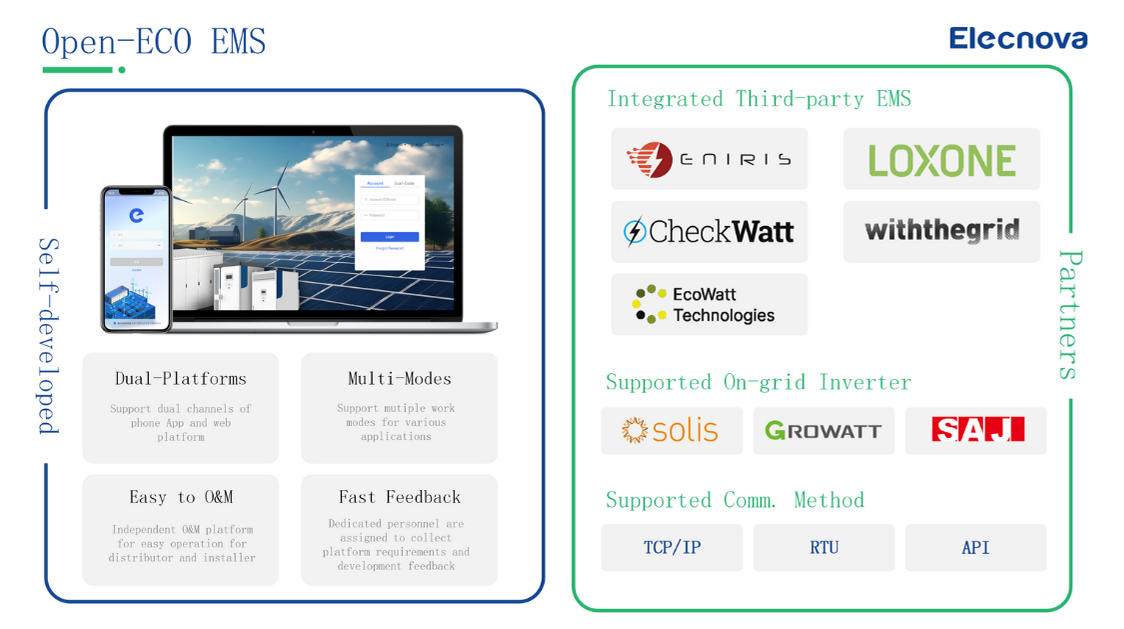
ECO EMS Platform
Conclusion
AC-coupled energy storage transforms photovoltaic generation from intermittent power into dispatchable, grid-compliant energy.
With its high-voltage AC design,integrated architecture,and advanced safety and control capabilities, the ECO-E418LP provides a reliable foundation for modern utility-scale PV storage deployment.
Contact Elecnova to design your AC-coupled PV storage solution.




 CN
CN EN
EN
 fr
fr  de
de  es
es  it
it  ru
ru  ar
ar  vi
vi  tr
tr  th
th